
FFSS can be used to find, plan, implement and quality-assert specific actions/activities that are needed to create a kindergarten, school and upbringing environment that contributes to health, well-being, play, learning and inclusion.
FFSS will help turn laws, regulations and good political intentions into practical and concrete actions.

The model should make it easier for adults in different roles to work purposefully to promote safe and good communities, prevent and stop bullying and abuse, and provide support to vulnerable or at-risk children. This work should not be in addition to, alongside, or instead of other activities.
FFSS should be part of everything we do, all the time. That adults have a common understanding, common strategies and work together as a team is especially important for success in working with each individual group of children.
Download : Download the planning sheets for the FFSS model
The FFSS model step by step:
Promote – how do you promote health, learning, play, well-being and inclusion?

To promote means to initiate something, to make something happen or to contribute to something happening. It means to take an active role in the work of facilitating and creating a safe and good community.
But what can adults actually do to promote a safe and positive community where everyone can participate and experience belonging?
- Find an activity that everyone in the group can participate in.
- To achieve this, it is a good idea for you as adults to talk to each other and share experiences. What types of activities have worked in the past? What do the children like?
- Involve the children in identifying fun joint activities.
- As an adult, you must be particularly concerned that the activity is suitable for those who are particularly vulnerable.
Now that you have agreed on an activity that you think is good for promoting community and belonging, the next step is to consider what you need to prevent and how to do it.
Prevention – how to prevent for health, learning, play, well-being and inclusion?

Prevention means actively doing something to prevent something from happening. It also means actively and systematically seeking knowledge about what is happening and going on in the children's group, and then actively and systematically developing and implementing measures to reduce the risk of children being exposed to bullying, abuse or exclusion.
But what should adults actually do to prevent bullying, harassment and exclusion in the chosen activity?
- Make an overview of the unfortunate events that could occur in the selected activity.
- Check with the other adults to see if they have any thoughts about possible challenges, so that you get the best possible overview.
- Talk to the children about what might be difficult when working together in this activity.
- Agree on 2-3 simple rules to remember for the children in this activity.
- Get the children involved in saying something about how they should treat each other and what they should do to cooperate well.
- Create some rules of thumb for the adults about what to do if someone doesn't follow the rules of thumb.
- Seek advice from the children on what they think should be done if someone does not follow the rules of memory.
- Contribute to a good and clear organization of the activities. Divide the children into groups, agree on what tasks each group has, which area the different groups should be in, and much more.
- Provide good information and ensure as best as possible that everyone knows and is aware of the framework for the activity.
- Pay special attention to arrangements for particularly vulnerable children when thinking about prevention and predictability.
Tip: Talk to the children about these rules at the start. Inform other adults about the same framework.
Stop – How to actively manage zero tolerance?
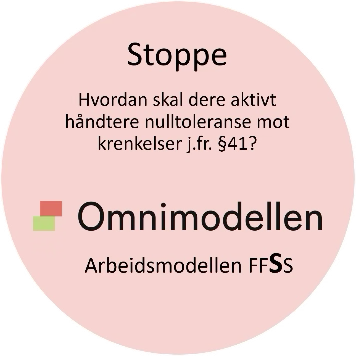
In all work with children and young people, it is important to have a clear attitude towards zero tolerance. In the work with FFSS, it is now assumed that you have completed the points about Promotion and Prevention so that you have established the framework for what is okay and not in this activity. This Framework should be the basis for standing safely in the adult role when you have to intervene and stop unwanted behavior.
Adults can intervene in various ways to manage zero tolerance. Below are some examples of how to correct negative behavior, provide reminders when needed, and confirm that you have seen your child make good choices.
- Correction – try to understand and acknowledge what happened and that you saw it. Comment on the action and be clear that the negative behavior must stop and that you will help so that the child is able to follow the rules further.
- Reminder – if you see someone starting to get restless or looking bored, feel free to give a reminder of the rules and what you expect them to do. Perhaps the child needs a little break.
- Affirmation – It is always a good idea to be aware of the good choices made by children. Acknowledge when the child does what you want, comment specifically on what you see, and give praise.
SUPPORT – How to support and help vulnerable children?

When children struggle to find a positive place in the community or struggle to achieve social interaction, it is our job to give them the support they need to do so. Adults must take responsibility for providing this support as an early intervention. The FFSS model is therefore not complete without this fourth point, which is about “support”. Here, you should try to plan support in advance of the activity as much as possible.
This point is about children who experience exclusion. Children who have low social status or experience an unsafe place in the group. Children who experience bullying and insults. Children who have been assigned negative social roles. Children who do not get to interact with other children. Children who are at risk of experiencing negative relationships with other children or adults. In other words, children who are to varying degrees vulnerable to experiencing belonging and significance in the community.
In the work on the last part of the FFSS, it is now assumed that you have completed the points about promoting , preventing and stopping. That you have established safe and good frameworks for what is okay and what is not okay in the activity in question. This Framework forms the basis for good planning, especially for those who need a little extra follow-up and facilitation to succeed in the activity:
- Review your overview of children with particular vulnerabilities in light of this particular activity.
- Does the child need to be part of a special group? Are there any special children who it would be a good idea to have in this child's group? It is also a good idea to think about whether there are any who should not be in the child's group for this particular activity.
- Is additional information about the activity of the child and parents necessary?
- Do you need to have any extra equipment ready for this child?
- Does the child need extra reminders just before and during the activity?
- Is it important that any specific adults are present with the child during the activity?
Summary and planning assistance
In the ongoing work to promote a safe and positive community, prevent bullying and harassment, and enforce zero tolerance, it is particularly important to keep the vulnerable children in mind. This is so that you, as an adult, can help them engage in positive and positive activities.
FFSS can be a good tool for finding, planning, implementing and quality-assuring specific actions/activities that are needed to create a kindergarten, school and upbringing environment that contributes to health, well-being, play, learning and inclusion.
NB! All tools must be seen in context to ensure a holistic understanding. All video lectures can be freely used in the work of increasing knowledge and understanding.