
Theme 2: Everyone needs a place to belong
The need to belong in a community is a fundamental need for all children and young people. Here you will learn more about why belonging is so important for children and young people.
In this topic, you will gain knowledge and understanding of the importance of building a safe and good sports environment.
We know that for many children and young people, the need for belonging is one of the most important reasons to start playing sports.
"Experience community and feeling included is a fundamental need, and important for children and young people's development, learning and well-being."
The opposite of belonging to a community is what we call being outside. The experience of being outside can be experienced in many different ways. It can be, for example, the experience of being different, not good or clever enough, or that it doesn't matter whether you come or not.
When we know how important it is to experience belonging in a community, the experience of being excluded is correspondingly difficult. In fact, it is so difficult to experience being excluded that when we check what happens in the brain when you experience being excluded, we can see that the brain reacts in the same way as if you were subjected to a punch, kick or violence.
Reflection task:
- Individual : What communities do you have as an adult? What is it like to be in these communities? Have you ever felt insecure in a community? What was that experience like?
- Group : How would you describe the community in the sports group you know best? Is there anything that could be improved, and if so, how?
- Club : How would you describe the club's work to build a good community for everyone?
Understanding green communities
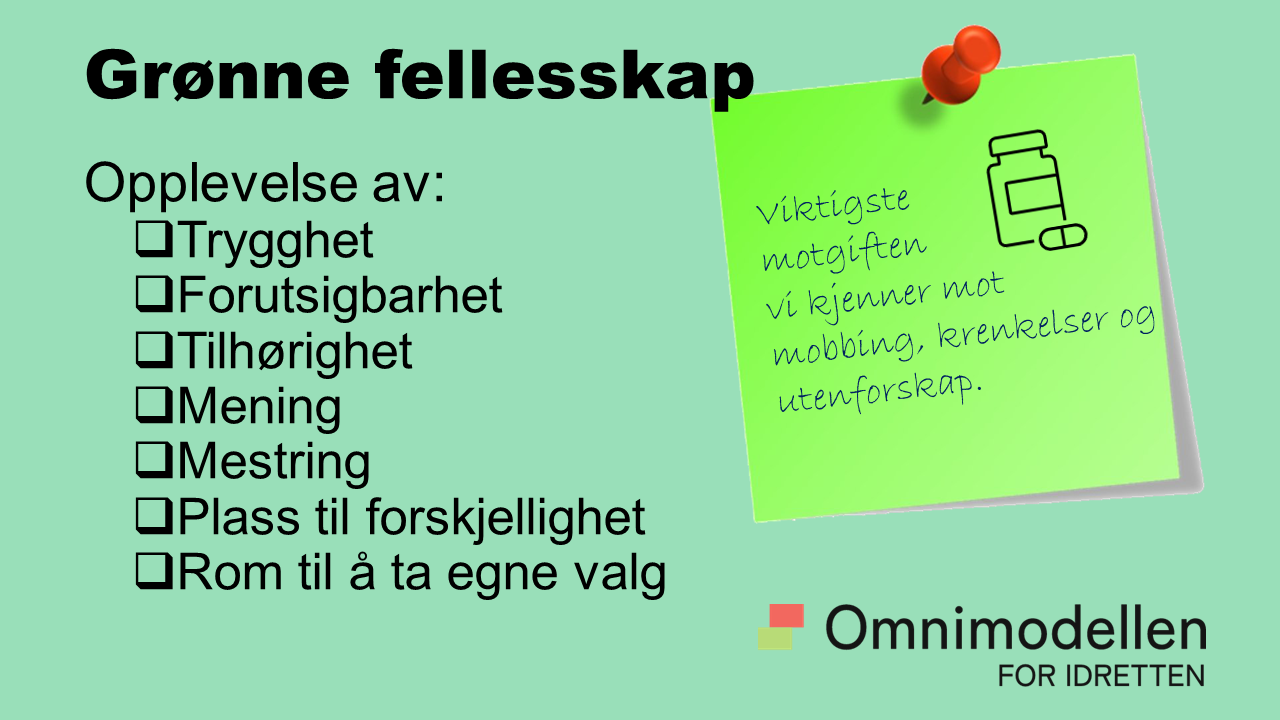
Security
Firstly, safety is about not being subjected to punches, kicks, bullying and insults. That you feel physically and mentally safe. But it is also about knowing those who are there, knowing what kind of rules apply and what is expected of me.
Predictability
Predictability is about knowing what is expected of me, knowing what is going to happen, knowing what framework we are supposed to be within. The fact that something is predictable is closely linked to the experience of security. Predictability from a coach/adult perspective can be characterized by, for example:
- The individual athlete knows what happens when they arrive at the training/competition arena.
- There are well-known rules and routines surrounding the start of training and competitions.
- It is known what the consequences of violating the rules are and that they are implemented.
Predictability means I know I'm welcome.
Affiliation
Belonging means that I am allowed to mean something in the group. I am allowed to contribute. It matters whether I come or not. There is reciprocity in the relationships in the group. In the Omnimodel for sports we are clear that we use the concept of belonging and not the concept of inclusion.
Here is an example of why we choose to use the term belonging and not inclusion:
There was a girl who gave a very good story about being included, but not feeling like she belonged. In the soccer team, it is planned that when practice starts, the players stand in a circle of 5-8 and pass to each other until everyone has arrived and practice starts. The girl goes to the coach and says that she feels so left out. I feel so alone. I feel like I can't be there. I'm not allowed to be a nuisance to the others. The coach says that everyone can be there. And then she said, yes, but that's not what I mean. Yes, but just go and stand in the circle, a nuisance to the others, and then you pass like everyone else.
She was included, and she was also seemingly welcome. But then she took it a step further, and said that it's like when I enter the ring, no one talks to me. And if I try to say something, no one answers or cares. They might nod a little, but I just kind of stand there. And that's what she meant. She was included, but she also felt left out.
She said that whether I'm in or not, it doesn't matter to the others. And what she put into words in that little story was the feeling of belonging that was missing . And the feeling of belonging is closely connected to the others, predictability and security.
When we experience belonging, we feel safe. When we experience belonging, we also fulfill the next basic need, which is the experience of meaning.
Opinion
Meaning is about what we are doing making sense. It means that we are creating something, achieving something, producing something, or that someone is happy to see you. We may need to think a little bigger about meaning. Maybe there is a day when you lack a little motivation, are a little tired, maybe have a little soreness. Then it may not make much sense to come to training, and at least not if no one cares whether you come or not. Meaning can simply be feeling like part of a community. And this is connected to the next point, which is coping.
Mastery
The experience of mastering what is expected of you. We can look at mastering both athletically and socially. Mastering friendships, mastering being a team player, or mastering taking the space and space you need, but also mastering the exercises that are given in training. If I do not experience mastery, there is a high chance that I will not experience meaning either. If I lack meaning and mastery, something also happens to the experience of belonging. So everything is connected. If I experience mastery, then I am also safe. If I am safe, it most likely has something to do with predictability. These elements are closely related.
Difference
In a green community, there must be room for diversity. We have different stories, different families, different talents, different interests, and different motivations for participating in sports. If I can belong to a community with room for diversity, then I can feel that I am good enough just the way I am. I can come and be who I am.
Room to make your own choices
The last point is that in a green community there must be room to make my own choices. That I can make choices based on what I believe in, what I stand for, that I don't feel compelled to pretend to be someone else. That my vote also counts.
When we have all these basic needs fulfilled, something happens inside us. Then we don't have to search for them. We don't have to worry that something is missing. It gives us room to try, room to make mistakes, room to be generous and generous towards others. We don't need to single out others, or gossip or point fingers. If we get these needs fulfilled, it is also the most important antidote to bullying, insults and exclusion. In such green communities, a lot of capacity is released to cheer each other on and also create better results both individually and collectively.
Reflection task:
One of the most important aspects here is predictability. How do you as adults work to create predictability for the athletes in the group? How do we as coaches ensure that everyone experiences mastery in training?
Understanding Red Communities
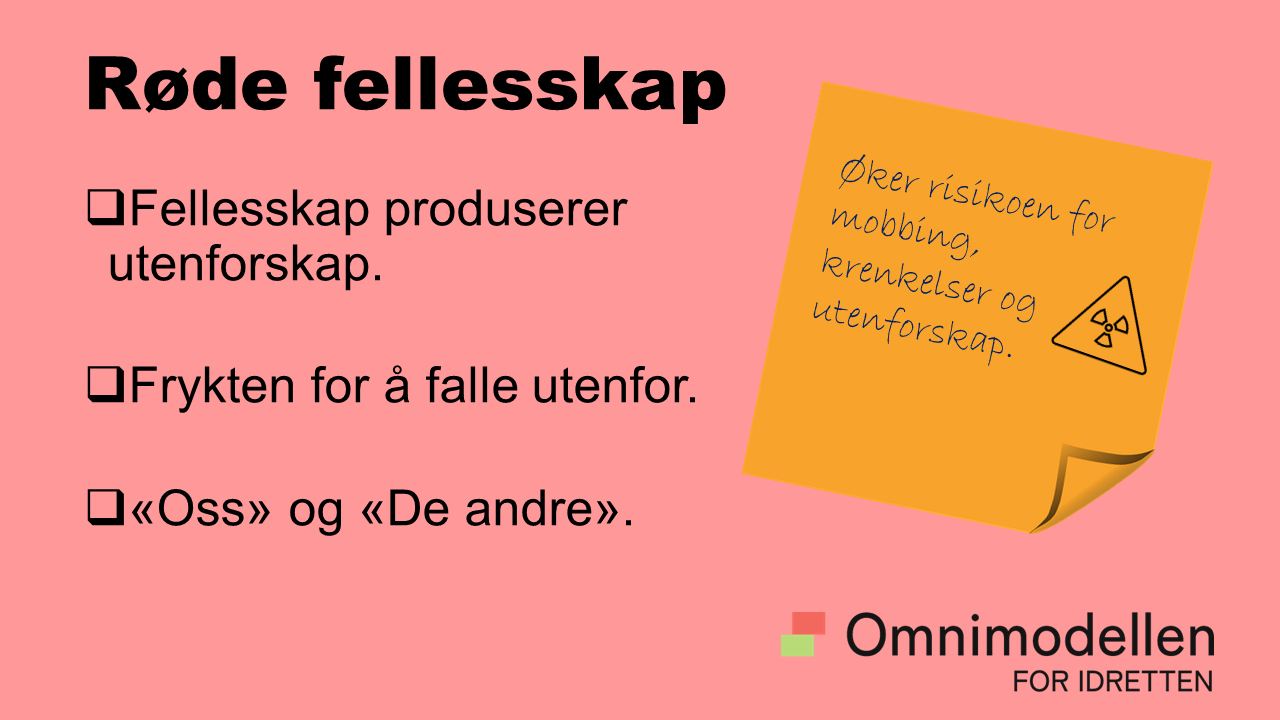
What happens when we get red communities?
The factors described under green communities can of course vary in quality. If the quality of several of the factors described under green community is too low, there is a great risk that the community will slip into becoming a red community.
When community produces exclusion
First, we know that it is the red community that produces exclusion. It may seem a little strange, but just the fact that some people experience a community can make others feel excluded.
An example might be if you have a group of friends who go to gymnastics together, they go to class together, they live on the same street, they have a close bond with each other. If they bring that into training and don't get help to see that they can't be exclusive to each other in the sports arena, there's a big risk that someone else will be on the outside.
If you have many such small communities that are closely connected, the probability of some people being outsiders increases. It may seem like everyone has someone to be with, but there is a great danger that there are strong ties within the small communities that prevent others from entering. Who is allowed to enter such communities is often controlled by the group itself and it is up to the children/young people to decide who is good enough for that particular group.
The fear of falling outside – Us and the others
As described earlier, the need to belong to a community is a strong driving force. The vast majority of people have this driving force. The fear of being ostracized or kept out of the community is painful. This fear can mean that if I feel my belonging is threatened, some driving forces are triggered in me that have the function of saving my place in the community. Then I can choose different strategies such as:
- I can take on the role of the coach's good helper, someone who cleans and organizes. This way I can look busy and not show the others that I'm actually outside the group.
- I can take on the role of the group's clown or buffoon. The one who comes up with jokes and creates a bit of mischief.
- I can make myself big, strong, tough and scary. You don't mess with me because...
- I throw nicknames and bad words around. Because it's also a role that protects me and my place.
- Another strategy I can choose is to find myself another community. Make it my community with a clear distinction between us who are inside and those who are outside. This is often not about not really wanting others in, it's just that I'm afraid that if others come into our community, I'll end up alone again. This fear of falling outside, and the strong need to belong to the community means that we sometimes join communities that are doing things that we don't really believe in or stand for just because we're afraid of falling outside.
- We can call such communities "Just do as we do" communities.
- Examples of such communities could be joining a group that engages in naughty activities such as nicknames, bullying or insults towards others. I know it's wrong, but the community draws me there. For example, gossiping is a typical thing. It creates a sense of community to join in.
We want sports to be a positive "Join in what we do" environment. Gymnastics, soccer, swimming, climbing and much more. This is where sports can have a lot to offer when it comes to finding a positive community to belong to.
Reflection task:
- What can we do to create as many green communities as possible?
- Do you see any examples of red communities in your group? What can you do about it?
You can find very specific suggestions and ideas here:
Theme 3: Working to promote a safe and good community
Promote – Prevent – Stop – Support. Here you will learn a little about what to keep in mind when creating activities that promote community in the group.
Theme 8: Giving good messages
Being able to give messages and reminders in a good way is very important. Here you will find good tips on how to do this.
Topic 9: How we feel at home
Here you will find practical examples of how you can work practically to turn good values and visions into practical actions in everyday club life.
Topic 10: Tips and tricks
In this video you will get tips and tricks when leading training and sports activities. Learn more about the role model trick, the attention trick and the communication trick.
In short, you can start with:
- Say hello and use their name. Show that you are happy to see them.
- Make sure everyone is allowed to participate. For example, if we use a bit of selective attention, that some people we say hello to and nod a little, while others become a bit invisible, then there is a tendency for children and young people to copy this type of behavior. Those we favor, favor children and young people too. If we manage to be aware of it and build good relationships and see everyone, highlight the different qualities that are there, then we know that it promotes green communities.
- Cheer on all types of achievements:
- Cheer on different types of skills
- The one who works hard
- The one who does his best
- The one who misses the target but makes a very good attempt
- The one who scores goals
- The one who makes the pass
- The one who almost does the somersault
- The one who comforts the one who is hurting
- The one who helps up the opponent who has fallen
- The one who encourages others
- The person in charge of personal equipment
- There are so many things we can be conscious of highlighting.
Another tip is to be clear about what you expect. Be clear that you expect everyone to have a place here. We look around. We look out for each other. We include everyone. That's how it is here with us. And that you address it and that you are clear in your expectations and that you show it by being a good role model. Just by having a clear focus on expectations will probably contribute to us having the kind of community we want.
Reflection task:
- Reflect together on how you experience community in the group/team in light of what you have now learned in the topic “Everyone needs a place to belong.” Is there anything you need to find out more about and/or work on more?
- How can you do that then?
What different skills do children and young people need to have to succeed together?
Skills for success in training and development
- Waiting for a turn
- Be considerate of others
- Postponing your own needs
- Act as part of a group
- Be on time precisely
- Order of equipment
- Helping others do good
Emotional skills
- Recognizing emotions
- Regulate your own emotions in a good way
- Have empathy for others
- Tolerate and stand in discomfort
- Support others
Social skills
- Be considerate of others
- Recognizing norms and relating to them
- Cooperate
- Regulating each other's behavior
- Conflict resolution
- Take responsibility for your own behavior
- Postponing your own needs