
Theme 5: Omni staircase – a community in negative development
What happens when the environment in a group moves in a negative direction? How can we influence such a negative development in a positive direction?
Learn to recognize the environment in your group
In this topic we learn more about what happens when bullying and legitimization occurs in a group. For each step you will get a short explanation so that it will be easier to recognize the environment in your group.
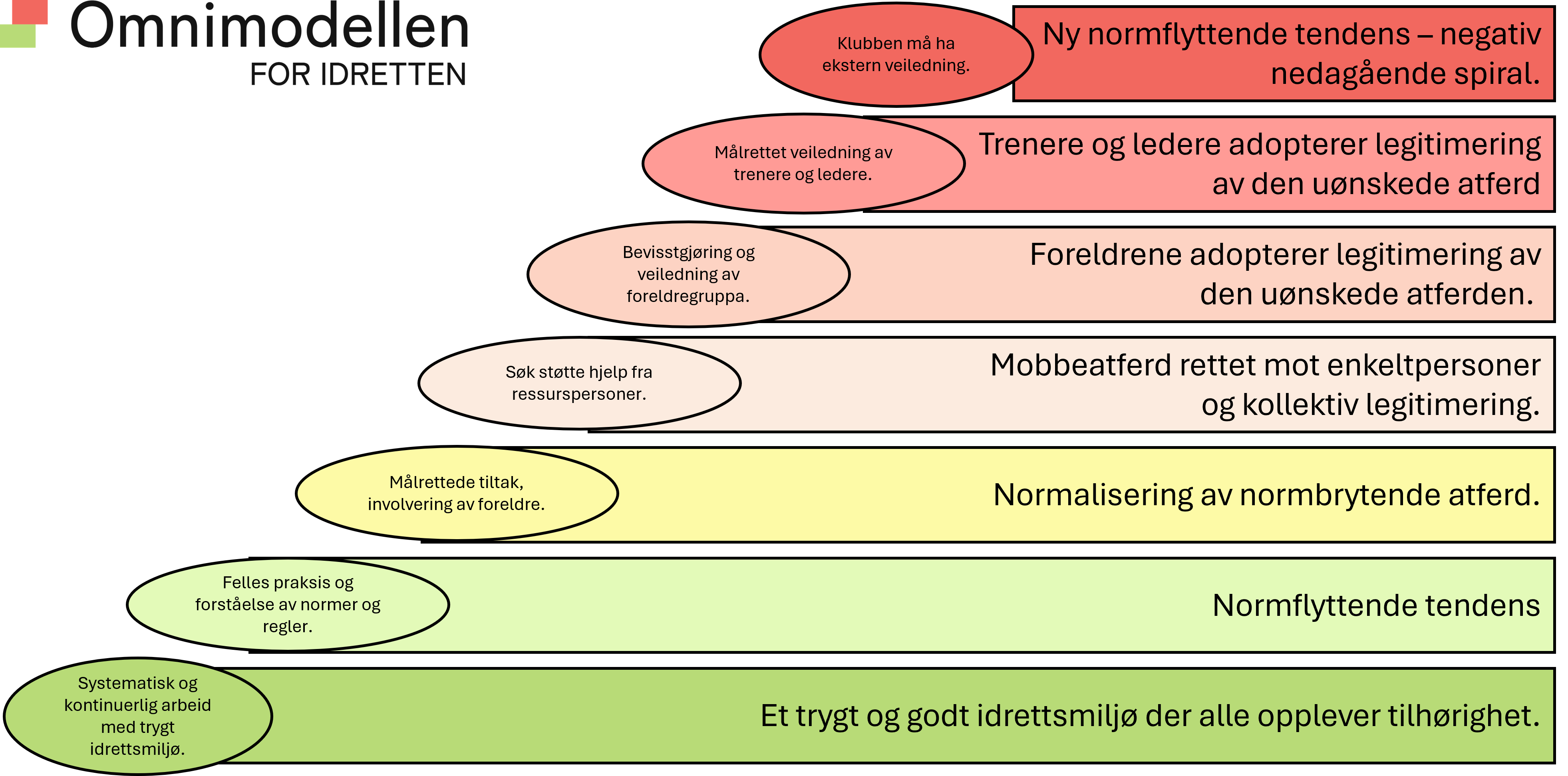
Step 1: A safe and good sports environment
Step 1 is characterized by safe and good relationships between everyone who belongs to the group. Good structures and routines that everyone follows, positive activities that everyone participates in, and adults who lead the group with clarity, care and warmth. Everyone has a positive and safe place in the community.
- The sports environment is characterized by interaction, good relationships and positive activity that creates belonging.
- The relationships between all participants in the environment are characterized by generosity, trust and continuity.
- The participants in the group tolerate each other well and recognize each other's differences, even across established friendship groups.
- The group of children and young people allows themselves to be guided through structures and routines, and they fulfill the expectations about how we are towards each other.
- We have a safe and good community that fulfills the needs for belonging, security, predictability, variety and diversity, and the experience of meaning.
Coaches, managers and parents have a common understanding and common practice. They have a common set of values and a positive view of children and youth in growth and development. The adults work continuously to promote a safe and good sports community for all, to prevent bullying and abuse, and to show a clear attitude towards zero tolerance.
Step 2: Norm-shifting tendency
Stage 2 refers to the exploratory tendency children and young people have to test boundaries, try and fail and challenge us adults. This tendency shows children and young people in growth and development – it is their way of orienting themselves in a complex world. At stage 2, children and young people need clear adults who are present in guidance and boundary setting.
When children/youth challenge established boundaries and norms, several things happen:
- Children and young people demand to be involved in establishing where and how the boundaries and norms will apply. (They are supposed to take over this function as adults).
- You determine where the boundaries are.
- It opens up opportunities for reflection on the current rules and norms.
- It opens up for reflections on elements such as tolerance, equality and worth, solidarity and belonging in a diverse community.
- This provides room for developing a positive culture within the club.
During periods when children/young people challenge norms and boundaries to a greater extent, the group is often characterized by more unrest and conflicts. It is experienced that boundaries and rules are stretched, and conflicts arise more often.
Your mission as a coach or leader is to guide, show the way, set boundaries and contribute to this orientation process. We are present and say:
- "In situations like this, we tend to do this and that..."
- "When this happens, we tend to think like this..."
- "Stop, we don't do that!"
- "This happened. How did he react? What do you think is the trick next time?"
We are there with guidance, support and boundaries. This guidance is a collaboration between coaches, managers, parents and other important adult roles in the sports environment.
When we guide, support and set boundaries for children and young people who are stretching and testing boundaries, we mark what is inside and what is outside. We draw the boundaries of the norms that apply. Norms are unwritten rules. A basic rule about rules is that they cannot exist if you do not mark where the boundary is. If the boundary does not exist or is not marked, the rule cannot exist.
Reflection task:
What might norm-shifting tendencies look like in your group/in your arena? How can you go about stopping such tendencies?
Step 3: Normalization of norm-breaking behavior
At stage 3, norm-breaking behavior has become established as normal among several in the group. This can be recognized by children and adolescents who do not fully follow structures and routines as expected, and who say or do things that are not allowed. Children and adolescents may express that adults do not understand their world.
- Children and young people who do not follow the established structures and routines.
- Language use among themselves or towards adults.
- A group/team that takes care of itself and does as they wish.
- Children or adolescents who ignore corrections or attempts at leadership.
- Children or young people who destroy, mess up or commit vandalism.
- Meat.
- Behavior that violates the norm we expect.
When normalization of norm-breaking behavior occurs, a new normal has been established for what one can and cannot allow oneself to do. The group of children and young people has taken control themselves, and created their own standard.
"You don't understand, that's how we are towards each other, that's okay"
Normalization of norm-breaking behavior tends to affect people differently. When children and young people "meat" each other by calling each other derogatory names, or by patting each other or hiding each other's things, it tends to hit some harder than others. For some who are exposed, it's not just a game. It's serious, and meant as such.
Step 4: Bullying behavior and collective legitimation
At stage 4, one or more people are exposed to bullying behavior. Bullying behavior is directed at individuals, and is behavior that violates what is allowed to be done to each other. People make explanations for why they allow themselves to do it, even though they know that it is not actually allowed. They legitimize / justify the behavior.
Most people who engage in bullying behavior know that it is wrong. Therefore, the legitimation process is important for bullying behavior to occur. Legitimation / justification is a strategy where one places the blame for bullying behavior on the person who is being bullied. One explains one's actions with characteristics, attitudes or actions of the person being bullied, which are intended to justify the bullying behavior. Our experience is that the legitimation process is often powerful and convincing, and that it is easy to fall into the trap of "understanding" the legitimation and participating in it.
Examples of identification can be:
- Collective agreement that the victim is strange or different, and therefore deserved to be treated worse than others.
- Collective agreement that the other was not treated differently, but is too close-minded and cannot cooperate or do the activity at the same level as the others.
- Collective agreement that the person being victimized is to blame for unrest in the group/team.
Those who just watch
Others in the group who actively encourage or support the bullying behavior, or passively relate to it, contribute to stimulating the bullying behavior. Having spectators reinforces the experience of being violated for the victim, and can reinforce the bullying behavior in those who carry it out.
Step 5: Parents support the bullying behavior
Parents hear and experience stories about other children/young people who do not function like the others. Or they lack social skills or competence. Parents can understand children/young people's frustration with challenges in meeting these others.
Parents are often the closest to their own children, and that's how it should be. Unfortunately, parents are often not present at training, matches or tournaments and do not see for themselves what is happening and how the children are towards each other when they are together. When their children come home and tell about what has happened, they often have no other reference points than the child's own story. The parents perceive, through the children's and young people's stories, that there is a child in the group/team who is challenging and in various ways a nuisance to others. The parent group understands the children's frustration, and shares it. They hear repeated stories about a child who has become so angry that he has hit, kicked and destroyed the training. The child does not understand the social rules of the game or appears strange and different.
When children who engage in bullying behavior also receive support from their parents, and the parents adopt the children's legitimization of bullying behavior, we have come a long way in the negative development. The child who is exposed to bullying behavior can also have the parent group against him, and be completely played out. The bullying behavior has taken on a more serious character, and has reached a new level, where the parent group is also involved in bullying behavior through passive legitimization.
Step 6: Coaches and leaders support legitimization and bullying behavior
Coaches and leaders see and experience children/youth who do not function like the others, who lack social skills, competence or have other challenging traits. One understands the frustration of other children and young people about the challenges in the face of this one. One sees and experiences the results of bullying behavior, but not the invisible social mechanisms that put the bullied person out of the game.
Just as parents can be misled by convincing legitimization, so can coaches and managers in sports. The social structures that underlie bullying behavior, the distribution of roles, and social hierarchies are not visible to the naked eye.
What is visible is the victim's reactions. An additional burden can often be that one must react and stop the victim's reactions in cases where they are physical in the form of punches and kicks, verbal in the form of swear words, or in some other way of such a nature that they must be stopped. The victim may have reacted with behavior that we "understand" that others react to, at the same time that we find it difficult to understand the victim's reactions. We see the reaction isolated from the whole, and react with correction, and do not understand the reason for the reaction.
Reflection task on your adult role:
Here are some statements that are often heard among adults in different roles. Go through the statements and talk about them in light of what you have now learned about the different steps in the Omni staircase.
- "He has to endure a little"
- "No wonder he doesn't have friends, he's so grumpy!"
- "This isn't that serious"
- "She is very cunning"
- "She probably has some blame for this herself"
- "She just wants to run around and ruin the activity"
- "Don't have time."
- “Children should learn to sort things out themselves.”
- "It will only get worse if you interfere."
- "It will probably pass."
- "It doesn't seem that serious/it doesn't go that deep."
- "The roles are switched, that applies to everyone."
- "It's no use what we do, as long as the parents keep doing it like that."
Step 7: New norm-shifting tendency
The bullied person is now socially marginalized, and is now completely dependent on adults who see and understand how bullying behavior and legitimization are self-reinforcing and self-fulfilling. If the process is allowed to continue, the boundaries that were moved in step 2 can be moved again, and we enter a new round of the ladder where each step has become even more serious.
When the negative development has progressed to stage 6, we have a serious problem in the group / team / club. When the negative behavior also apparently has support from parents or the parent group, in addition to one or more coaches and managers, everything is in place for a new norm-shifting tendency to occur. This time, it is the new norms that are shifted again. The behavior takes another step in a negative direction and the situation is in a serious development.
At stage 7, where a new norm-shifting tendency occurs, we have a very serious situation in the group/team/club and the environment in the children's group is not safe and good for anyone.
The person or persons who are exposed to bullying behavior are in a particularly vulnerable situation where they are highly dependent on safe and courageous adults who see, understand and act, and who are able to implement correct, targeted and effective measures to stop and reverse the negative development.
Reflection task:
The team has major challenges in the environment and several are considering quitting as it is no longer safe to be at training. Bad language, comments and harassment by opponents and referees are common. Two of the players have experienced equipment being broken in the locker room several times. How can you address such a situation?
Reflection task on your adult role:
Here are some statements that are often heard among adults in different roles. Go through the statements and talk about them in light of what you have now learned about the different steps in the Omni staircase.
- "He has to endure a little"
- "No wonder he doesn't have friends, he's so grumpy!"
- "This isn't that serious"
- "She is very cunning"
- "She probably has some blame for this herself"
- "She just wants to run around and ruin the activity"
- "Don't have time."
- “Children should learn to sort things out themselves.”
- "It will only get worse if you interfere."
- "It will probably pass."
- "It doesn't seem that serious/it doesn't go that deep."
- "The roles are switched, that applies to everyone."
- "It's no use what we do, as long as the parents keep doing it like that."