
Written by Elisabeth Maarnes (Omni supervisor in Fauske municipality)
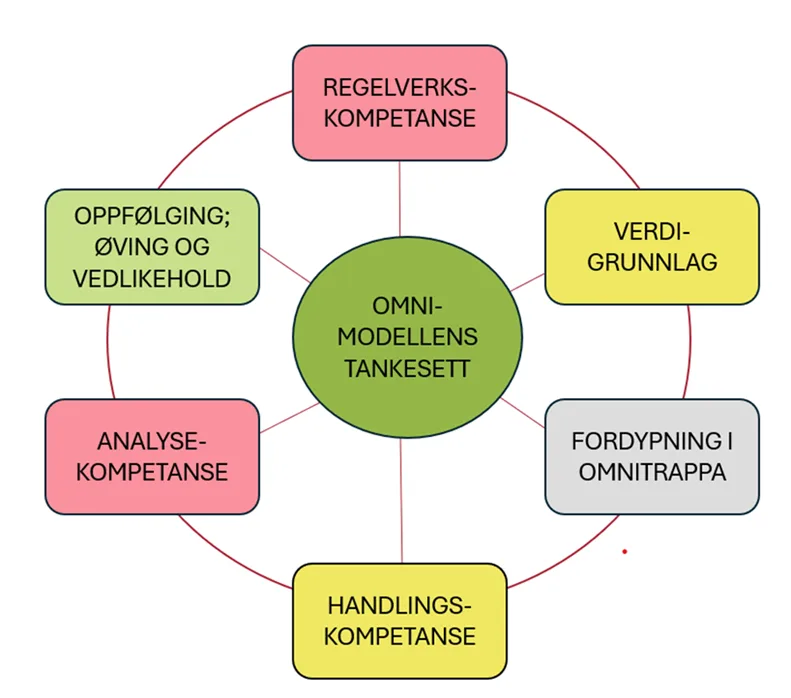
The Omnimodel constitutes both a mindset, which requires professional insight and systematic work with the organization's values, and a set of tools, the use of which requires insight. The core components of the implementation of the Omnimodel are competence development through seven steps (see figure above). All steps are dependent on each other and are part of a continuous process.
To successfully implement the model, we must work interdisciplinary and holistic ways. It is not enough to work on one point at a time. Real change only happens when values, insights, tools and actions are connected. It all starts with a shared understanding of the mindset.
All seven core components of the Omni Model are interconnected. You can’t work on one component without touching the others. If we only focus on tools, we lose sight of values. If we only focus on values, we lack strategy. And without context, we don’t see what’s actually going on.
Step 1 – Mindset: The mindset is the very core of the model. This mindset represents a holistic way of understanding, meeting and supporting children and young people – a way that shapes how we think, act and collaborate in everyday life. The mindset must be anchored at all levels of the organization – not just as theory, but as a living practice. It should characterize how we talk to each other, how we meet children and young people, and how we make decisions in everyday life. To build a common platform, everyone involved – from managers to professionals and employees in direct contact with children – must develop a common understanding of steps 2-7.
Step 2 – Omnitrappa: A tool for identifying and reversing negative developments in the learning environment.
Step 3 – Analytical competence : The ability to see the often invisible social dynamics, as well as the link to action competence; that is, knowing how and when to act.
Step 4 – Action competence: This should enable us to do something with what the analysis competence helps us to see. Here, it is not enough to have good systems. We must also understand the cultural and relational context in which we work. It is about seeing norms, expectations and invisible mechanisms that influence children's experiences in kindergarten, at school, in leisure activities and online, and being able to do something with what we see.
Step 5 – Regulatory competence: Shows how we translate laws and guidelines into practice that safeguards the rights and safety of children and young people.
Step 6 – The value foundation: Our professional ethics, our view of humanity, and our beliefs about learning and development guide everything we do.
Step 7 – Follow-up, practice and maintenance : We are required to have continuous focus, reflection and follow-up. We must constantly check with ourselves whether we are working in line with our values, whether the measures we have initiated are having the desired effect and whether we are listening to the voices of children and young people.

Concrete tips for implementing the Omnimodel:
- Preparation of a position analysis that can function as both a starting point, a guide and a quality check with regard to the effect of the implementation work.
- Preparation of a concrete implementation plan that contains a clear division of responsibilities, a concrete progress plan that ensures operationalization of goals, and quality follow-up along the way. This plan must be a living document that is evaluated and updated continuously. Refers to examples of implementation plans for Fauske municipality and Tromsø municipality.
- It must be clear that there is a focus on implementation: Sufficient time and resources must be allocated.
- Work must be done holistically and continuously, with a focus on shared understanding and shared practice as opposed to private practice.
Here you can read more about implementation and see examples from Tromsø and Fauske!